

From eight From eight tracks to three: how Code Europe's program changed in a decade
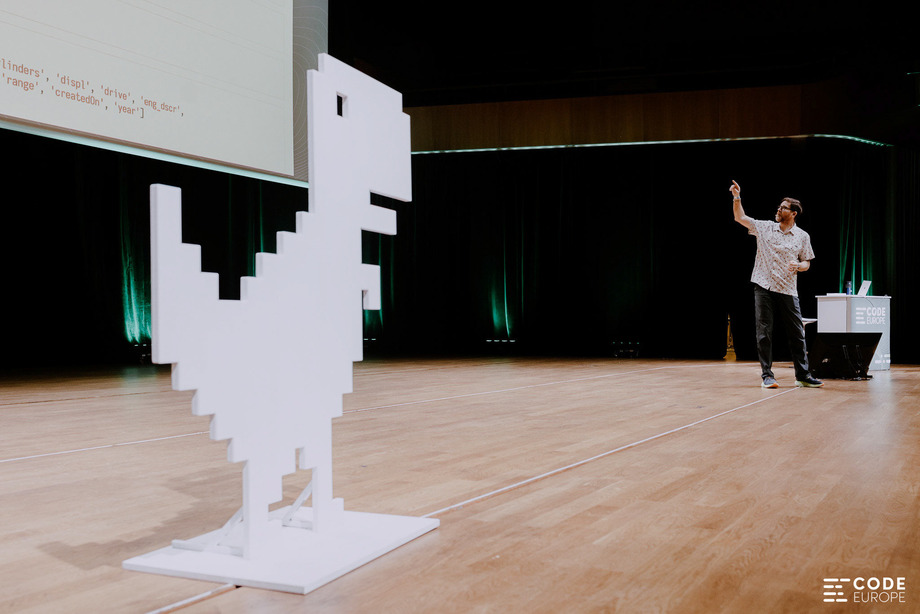
The Code Europe agenda in 2016 didn't look like the Code Europe agenda in 2026. That's not an accident, and it's not a marketing reinvention either. The shape of the festival has tracked the shape of the work the audience actually does, and over ten years, that work has changed substantially.
This post is about what changed, why, and what it means for the people picking the talks. It's also about the editorial discipline behind the program: how a talk earns the stage, what the agenda committee says no to, and where the line runs between the sponsor program and the curated content.
2016: broad by design
When Code Europe launched in 2016, we made an editorial choice that ran against the temptation to specialise early. We chose a broad program with many parallel tracks covering frontend, backend, mobile, QA, languages, and what we then filed under "future tech." Not because we couldn't focus, but because we believed (and still believe) that software development is fundamentally connected work. The interesting problems live at the seams between disciplines. A backend engineer benefits from understanding the constraints the frontend team faces. A senior developer benefits from stepping outside their primary specialisation more than from burrowing deeper into it. A conference that drew its boundaries too tightly would have closed off the conversations senior developers actually wanted to have.
That conviction carried Code Europe through nine editions and almost 39,000 cumulative participants across Warsaw, Kraków, and Tricity. The wider catchment wasn't a compromise. It was the point.
Then AI arrived
In the span of roughly twenty-four months between late 2022 and 2024, the working life of every software engineer changed. The quotation marks around "sudden" feel earned. "AI engineer" went from a non-existent job title to one of the fastest-growing senior roles in the tech market. Teams that had never staffed against generative AI a year earlier were running production LLM systems. Coding assistants moved from novelty to default tool. Engineering work that used to sit in predictable lanes started bleeding into AI-adjacent problems that didn't have established patterns yet.
The shift isn't just visible inside the Polish job market. Stack Overflow's 2025 Developer Survey, with more than 49,000 responses from 177 countries, found that 84% of developers were using or planning to use AI tools in their work, with 51% of professional developers using them daily. That's up from 70% adoption in 2023. The day-to-day reality of writing software in 2026 is empirically different from the day-to-day reality of writing software in 2022.
Naming the shift early, Shawn Wang of Latent Space wrote in mid-2023 that software engineering would "spawn a new subdiscipline, specializing in applications of AI and wielding the emerging stack effectively, just as 'site reliability engineer', 'devops engineer', 'data engineer' and 'analytics engineer' emerged," predicting that AI Engineer "will likely be the highest-demand engineering job of the decade." Andrej Karpathy, OpenAI co-founder and former director of AI at Tesla (now with Anthropic), put it more provocatively the same year: "the hottest new programming language is English."
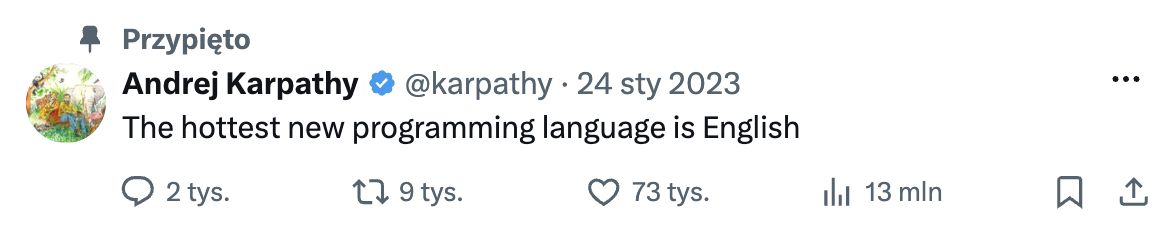
Three years later, those framings are no longer contrarian. They describe the shape of the work.
What this doesn't mean is that AI replaces the engineer. The same 2025 Stack Overflow survey found that 72% of professional developers do not use "vibe coding" (generating entire applications from prompts) as part of their professional work, and 64% do not see AI as a threat to their jobs. Full-stack and backend roles remain the two largest specialisations for the sixth year running. The realistic picture is one where senior developers increasingly act as architects, reviewers, and judges of AI-assisted code generation, while new specialisations (AI engineering, agent engineering, ML platform engineering) emerge to wield models as a substrate for products. The work changes. The engineer doesn't disappear.
This wasn't a gradual shift we could absorb into the existing program shape. It was a step change, and it raised a question we had to answer honestly: was the broad-conference approach still the right service for senior developers when the landscape underneath their feet had shifted this fast?
Two things told us the answer was no.
First, the new disciplines deserved depth, not a slot in a wider catalogue. AI engineering, platform engineering, the architecture work required to run AI workloads in production: each one was an entire conversation. Treating them as line items in a six-track buffet would have meant short-changing the topics the audience cared most about understanding.
Second, the Polish labour market told the same story from a different angle. AI and ML job postings on No Fluff Jobs grew 22% year over year in 2025 (the only major specialisation showing meaningful positive growth that year). Gartner projected platform engineering presence at 80% of large enterprise software organisations by 2026, up from 45% in 2022. The skills the audience needs to deepen and the skills the market is paying for are converging on the same three areas.
We still believe software development is connected work. The three tracks we landed on for 2026 are explicitly designed to be navigated, not chosen between. But the connections now run through AI as a force in the engineering world, not around it.
2026: three tracks, examined honestly
For 2026, we've consolidated the program around three tracks. Each one has a different centre of gravity, a different relationship to what's shipping in the industry, and a different definition of what counts as a good talk.
AI Engineering & Data. The centre is how teams move AI-powered systems from prototype to production. What gets in: agentic workflows and the engineering work that keeps them on the rails, LLM application engineering and context engineering as disciplines, Model Context Protocol integrations from teams shipping them, evals and observability for AI systems, AI-augmented development workflows with productivity data instead of vendor claims, vector databases and RAG at scale. What gets cut: research-flavoured talks without a production system to point to, abstract "future of AI" perspectives, vendor capability decks dressed as engineering content. The seams that matter: where AI workloads meet the platform layer (Track 2), and where agentic systems force new architectural patterns (Track 3).
Cloud, DevOps & Platform Engineering. The centre is the discipline of running modern infrastructure at scale, with platform engineering as the connective tissue between application teams and the underlying cloud. What gets in: internal developer platforms that engineers actually use, Kubernetes operations past the conference-buzzword phase, OpenTelemetry adoption with the failure modes included, eBPF in production, FinOps owned by engineering rather than finance, supply chain security in CI/CD, AI workload economics from the platform side. What gets cut: introductory Kubernetes content, "we picked X over Y" comparisons without data, vendor product demos. The seams that matter: the platform-AI seam (where production AI lives) and the platform-architecture seam (where infrastructure choices become design choices).
Software Architecture & Engineering Excellence. The centre is the long-running set of problems that staff+ engineers, tech leads, and architects deal with every week: how to design systems that outlive the original team, how to influence at scale without authority, how to make engineering choices defensible to the rest of the business. What gets in: distributed systems retrospectives with real numbers, modular monolith case studies, modern language deep dives (Rust beyond rewrites, JVM modernisation including virtual threads and GraalVM, TypeScript at scale, Go past the microservices wave), API design trade-offs by use case, the staff+ engineer playbook. What gets cut: "best practices" surveys, language advocacy without production validation, architecture theory without a working system. The seams that matter: architecture-AI (how AI workloads reshape system design) and architecture-platform (where the IDP becomes the architectural substrate).
Three tracks is what we can deliver at the depth we want to deliver it. Six tracks would mean a buffet: broader coverage, shallower depth. Two of the three tracks describe disciplines that didn't exist as named roles in 2016. The shape of engineering work changed; the program had to change with it.
Where cybersecurity lives
We can do credibly embed security where developers and operators actually meet it in their working week. In AI Engineering, that's prompt injection, LLM output validation, and the question of how to safely give agents tool access to production systems. In Cloud and Platform Engineering, that's zero trust adoption, secrets management at scale, Kubernetes security posture, and CI/CD supply chain security. In Software Architecture, that's threat modelling, secure-by-design API patterns, OWASP for modern stacks, and dependency security past the basic auditing tools. Across the program, that's incident retrospectives from real breaches.
The agenda committee includes a dedicated cross-track security reviewer. Any proposal that touches security gets read by someone whose primary lens is security, regardless of which track it's submitted under.
A standalone fourth track for cybersecurity is on the table for 2027, once the community foundation is in place to run it at the same standard as the other three.
Two cross-cutting scopes round out the CFP. Practice & Careers (engineering leadership at the staff+ level, technical communication, the human side of platform and architecture decisions) lives across the three tracks rather than as a fourth. The selection bar is the same.
Why the agenda committee grew from 4 to around 12
The other big change for 2026: the people choosing the talks.
In earlier editions, the technical curation work was done by a small group of roughly four people doing the heavy lifting on speaker selection, CFP review, and track-level coherence. More than 450 CFP applications came in for Code Europe 2025 alone. That worked for a wider, shallower program. It doesn't work for what we're building now.
For 2026, we've expanded the agenda committee to around twelve engineers, architects, and platform leaders with deep technical credibility in the three tracks. The math is simple. When you're committing to depth, you need more expert eyes on the CFP, and you need track-level owners who can defend hard "no" decisions on talks that don't meet the bar. Four people can curate a buffet. Twelve people, properly distributed, can curate three deep tracks with genuine coherence.
A second reason: review volume. As mentioned, we are expecting another record number of CFPs, and we want to invite as many high-quality speakers as we can. Reviewing that volume at the depth we need takes a bigger team.
We'll be introducing the agenda committee in a dedicated post soon: the people, their backgrounds, and how the review process actually works.
What stays the same
The selection bar. No beginner content. No vendor demos disguised as talks. No "future of X" framing without a working system to point at. No talks given at five other conferences this year.
The audience profile. Senior engineers and builders, the architects, staff+ engineers, and tech leads making the calls. In 2025, 81% of attendees had four or more years of professional experience. Not students or career-changers.
The voice. Direct, technical, free of hype. The festival that asks speakers to tell you what didn't work, not just what did.
If you've been to Code Europe before, the 2026 program will feel sharper than what you remember. That's the intention.
Sources:
AI tool adoption among developers: Stack Overflow, 2025 Developer Survey (49,000+ responses, 177 countries); Stack Overflow, 2024 Developer Survey.
The emergence of AI Engineering as a discipline: Shawn Wang (swyx), The Rise of the AI Engineer, Latent.Space (June 2023).
"The hottest new programming language is English": Andrej Karpathy, X (formerly Twitter), January 2023.
Polish AI/ML labour market: No Fluff Jobs 2025 hiring data, cited via ITCompare.pl and Poland Insight.
Platform engineering adoption: Gartner, Platform Engineering Trends (April 2026); Roadie.io industry analysis.
Polish cybersecurity workforce gap: Lexology, Cybersecurity Workforce in Poland (2025); ISC2, Cybersecurity Workforce Study (2024) for the Europe-wide shortage estimate.
Polish cybersecurity market projections: DestCert market analysis (2025 to 2030 figures).
Code Europe attendee and CFP data: Code Europe internal data, 2025 edition.